A Buncha Baby Spiders

No, you don’t get a “trigger warning”

Here’s a peek inside the nursery of a local Steatoda grossa mom, who has wisely walked away from this clutch of little ankle-biters. No, not terribly maternal — but she does usually stick around with the egg sac for a while, even if she doesn’t go in for college savings accounts or after-school enrichment. The only reason she’s not in view here is that I let her go after a few days’ captivity. This is another of my clumsy attempts to take macro photographs (I hope to take a class this summer and really figure out what I’m doing.)

When the silk's astray, the spiderlings will play.

When the silk’s astray, the spiderlings will play.

Steatoda grossa, as I’ve written about before, is a common garden species around these parts and well-traveled elsewhere. She’s related to the black widow and looks similar enough that you might have hopped around in a panic if you upended an old flowerpot or pair of garden gloves and sent her scurrying out. Well … “scurrying” is pushing it. She’s slow and awkward on foot, graceful only on the web. And she’ll be trying like hell to make for the nearest crevice or hole. If you catch her out in the open and she decides all is lost, she’ll crumple up and look dead, a technique that works for much bigger creatures, up to a point … let’s call that the “possum on the yellow line” point. Let her be and she’ll slowly unfold and skitter off. (Skittering, scurrying … what’s your favorite spider verb?)

The proud parent. Dim lighting means she can easily pass for a widow, right?

The proud parent. Dim lighting means she can easily pass for a widow, right?

There’s a very specific place in my domain where Steatoda likes to hang out, and I find it interesting. We have a mealworm ranch in the basement. They started out as gecko fodder, then they were for the songbirds, and now my entrepreneurial boy — Steve Jobs 2.0 — is launching a mealworm business and is hounding a local pet store to take us on as a supplier. Locally sourced food is all the rage, do we not know? He’s designed the containers, come up with a name, and launched on Facebook. I never realized mealworms, technically larvae of darkling beetles (Tenebrio molitor), were both so universally delicious and so astoundingly fertile. Or maybe we’re just good at invertebrates . . .

Anyway, though the larva is all Chez Panisse to everybody, the adult form, the beetle, is not. Clumsy little black bugs, easily overturned, spared an early death because of being so darkling … or something. Neither gecko nor bird will deign to try them. But Steatoda, as it turns out, does love the beetles. Every time we tidy up the mealworm ranch or change containers there’s a cobwebby superstructure in and around the boxes, occupied with lots of fat glossy spiders and the leftovers of recent meals. It was scary the first time, since it appeared we were breeding black widows and even our placid neighbors would have arisen with flaming torches if they’d known that. But a closer inspection showed them to be Steatoda, who is more accustomed to misidentification than the average arachnid, and who does not bother us.

Still, I like to gather up these false widows and put them outside, where there are old pots and leaf litter aplenty. The brood pictured above were placed in the corner of a raised planter bed to fend for themselves. I expect to see them again.

Zoropsis raids the refrigerator

“I heard my wife screaming”

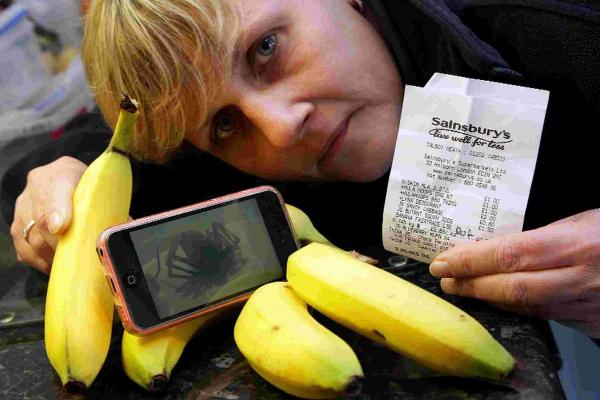
That’s always a great way to start a spider story (thank you, Courier.co.uk), and sadly typical. This unhappy couple were keening over the discovery of a cold, sluggish spider in their refrigerator, which Scottish newshounds lost no time in identifying as an “Indian wolf spider” because it was found huddled near some imported grapes. I knew this guy right away, and so will you if you click that tab on the right that says “Zoropsis.” Yep, this looks like our good friend Zoro, this time caught in a Scottish icebox without his kilt.

Aye, cold it is in Scotland, colder still the reception!

Aye, ’tis cold in Scotland; colder still the reception!

“This spider could give a nasty bite but thankfully no one was harmed,” says an animal-control officer on no evidence whatsoever. You’d have to be off yer haggis to think Zoropsis spinimana was ever going to harm anybody. Bite? I don’t know, if you poked him in the face he might take that amiss. But these rugged Scots, equipped with all their spider-avoidance equipment, didn’t need to worry about that anyway. Thank god, again, for manly Scotsmen who stave off the beasties while their women find time first to scream and then to call the tabloids. (I’m saying “him,” but I can’t tell from this angle if the spider has the characteristic male palpal structures. I was joking about the kilt, but too bad it’s not as easy as hoisting one’s garments to tell a spider’s sex.)

Yeah, but it is pretty easy to rule it out as a “wolf spider.” Just because it’s brown? And patterned? Let’s call anything that has fur a … let’s see … I know, let’s call it a DOG. Good working hypothesis, until we get an actual expert to bear down on the question, which in this case will be never.

And I like this, um, expert who opines that you can tell it’s a weird spider because “unlike house spiders, its eyes are at the front of its head.” Forward-facing eyes, who knew? Don’t let all the other tens of thousands of spider species hear about this, they’ll be wanting forward-facing eyes, too! All because of small-town David Hume here and his rigorous evidence.

And lo, you don’t even need to don your pith helmet and steam off to India to find Zoro’s family: that tricky Internet thing shows that Zoropsis–known for spreading beyond its Mediterranean range, including to the San Francisco Bay Area–is already established here and there in Britain. So brave up, Braveheart, and say hi to Zoro.


“Dinner’s on me,” he says . . .


Table for one, please

If you ponder the question of why female spiders frequently eat their mates (frequently, not always) you sometimes arrive at the question, “Why not?” They’re usually solitary creatures, those spiders, with nothing to say to each other, no shared hobbies or interests, and they refuse to stay together for the children. In fact, sometimes they eat the children, but that’s another story.

A spider man that tumbles into a female spider’s embrace is likely to be smaller than she (easier to overpower), eager to get perilously close to her fangs, and a nice packet of nutrition for the future mother to be. All of which makes great sense … for her. But is a fella more than just a snack?

It turns out to be rather more mysterious. And I like mysterious spiders. A new study of wolf spiders in China (Pardosa pseudoannulata) tried to tease out the matter of who eats whom, how often, and under what circumstances. Was she just hungry? Was the luckless suitor too inexperienced? The scientists paired off dozens of spiders, both virgin and experienced, and tabulated a number of different ways the blind dates turned out.

I am Pardosa, hear me roar. Where's that bum that promised me dinner?

I am Pardosa, hear me roar. Where’s that bum that promised me dinner?

Ten percent of the virgin females ate their dates without even mating. Twenty-eight percent ate them right after mating. Both hungry gals (as opposed to recently fed) and those who had previously mated or laid egg sacs were more aggressive than the debutantes. The bigger the size differential (dimorphism) the more likely the male would become a meal. Nobody got eaten during the act itself. All very gothic and kind of comprehensible.

At this point, do the numbers … most of the males therefore got away. That’s interesting in its own right. More interesting is what follows.

There turned out to be a clear result from all these enchanted encounters: the females that had noshed on a male after mating had the same number of offspring as those who hadn’t (in other words, fecundity was unaffected) but those offspring survived better. They were vigorous spiderlings who looked to have a better shot at making it to adulthood. That rings the Darwinian gong in the clearest possible way: cannibalizing a mate gives your progeny, your genes, a leg up—eight legs up—in the grand contest with no finish line.

I have to chide the Economist, which otherwise I honor and adore, for reporting on this phenomenon with a lack of journalistic objectivity. It’s so hard for the Brits to think straight about spiders. The male “thus probably … wants to be eaten, for the good of his posterity,” writes Reggie or Nigel. And the salmon swims upstream to spawn because he wants to star in a Discovery Channel documentary, right?

Of course not. Spiders and salmon don’t want anything of the kind. Nor do they set up IRAs and college accounts for their offspring. If daddy long-legs’ death contributes to the hardiness of baby long-legs, than it’s going to happen. You don’t need God or Dr. Spock to coax it along. We packets of DNA do things like that because our ancestors, having done them, thrust their genes into the future, our present. And we will continue doing the things that work, because they have worked.

A remaining question, in the Mystery of the Dined-On Daddy, is what exactly his little carcass does for his mate and her egg sac. Nobody knows what the secret ingredient is, if there is one. Maybe the least romantic females were already equipped to make better offspring, so the male just managed to get a bad spin on the Wheel of Life even as his genes hit the jackpot.

At any rate, dude probably should have learned to dance.


Spider makes its own piñata

The artists among the Cyclosa community — those small orb-weaving spiders, known for decorating their webs with trash — are getting better. At least in one corner of Peruvian rainforest, where someone with an ecotourism company spotted this tiny sculptor having an exhibition at roughly eye level. Now, the trash-line spiders have long been observed cluttering up their homes purposefully. It’s not that they’re lousy housekeepers. It seems that if you compile a, well, pile of dead bugs and other debris you might attract more predators, but those predators will have a lesser chance of picking you out among the junk. Smart, those spiders. What you call a strategy of pre-emption.

But this photo by Phil Torres of Rainforest Expeditions is yet more marvelous. Walking among the brush, Torres spotted what he thought was a live spider wiggling and twisting in a web. But it looked off … flaky and dried-out. As well it should, since it was made of bits of leaf and bug body parts. The actual spider was right nearby, tinier than its mummy, and it apparently was giving the web a twang now and then to make the scarecrow move about realistically. Torres found multiple members of this still-unidentified species not far away.

The artist atop its creation. Good show, Cyclosa! © Phil Torres

The artist atop its creation. Good show, Cyclosa! (© Phil Torres)

As much as I love to anthropomorphize, I know this small creature wasn’t thinking of Day of the Dead flair as it did its work. In fact, for all the amusement and fascination this image is sparking on the internet, it’s not clear that there was anything deliberate in the spider-shaped accretion. The silk lines do happen to converge there, spiders like to sit where the lines meet, and it’s possible the junk collection merely overflowed. Still, other Cyclosa research has shown that those who tend to make decoys usually build them about the same size as their bodies, which is interesting. If these spiders have an instinct for making scarecrows (scarespiders?), the legs are a natural next step. (Other photos on the site show effigies with eight legs, a realistic touch that really gives you pause). I like the contrast between the big, spooky decoy and the brisk, tiny spider doing the work.

If spiders can travel in space, I guess they can make piñatas too.


Ground control to Major Charlotte . . .

One giant leap for spiderkind – a lot of leaps, actually

The universe’s most well-traveled spider, a Phidippus johnsoni with the grand name of Nefertiti, died recently in what was supposed to be her quiet retirement home. Reporters made much of how this chunky, red-and-black jumper not only thrived in her 100 days aboard the International Space Station but withstood the rigors of launch, re-entry, and being shuttled about the country with apparent good grace. Nefertiti seems to have reached the end of her brief natural lifespan in the warm confines of an exhibit at the Smithsonian’s National Museum of Natural History.

Spiders have the right stuff, forgive me trotting out that phrase. They’re focused, efficient, and as taciturn as any Neil Armstrong. This particular arachnaut, a regular Sally Ride, had a simple mission that she performed with grace and energy: catching flies. And the wondrous thing: she did it in zero gravity, an environment no earthly spider could be expected to grasp. Think of those millions of years of earthbound instincts, honed to an unimagineable degree … and yet this jumping spider was all feh, I can do this—I’ll just adjust the trajectory here and the thrust there, disregard millennia of sensory input, and boom: bug soup.

What next! Spiders from Mars? Oh. Carry on then, Ziggy.

I don’t think any old spider could have done it. Jumping spiders are the brains of the outfit. Equipped with sophisticated, unblinking, networked cameras around their little heads, they see and hunt famously well. They’ve been observed sneaking up on prey that they can’t even see, calculating how to creep up under cover and burst out at just the right instant. It would be like you stalking a pizza delivery guy walking along on the other side of a tall fence, figuring out when he’s going to stop and tie his shoe or check his text messages, pursuing him around the corner, and then out you pop through a loose board and snatch his pie. Yep, it takes thought.

Nefertiti got her ticket to ride thanks to an 18-year-old Egyptian named Amr Mohamed, who won the YouTube Spacelab contest with his idea for a jumping-spider experiment. (There was a second arachnaut, a zebra-striped Salticus scenicus named Cleopatra, but alas, she died in orbit.) Once aloft, astronaut Suni Williams took the spiders under her wing and blogged about them. She remarked about Nefertiti: “She is sort of scary. I am so glad I am not a fruit fly. I opened up the habitat and actually saw her running around at full speed looking for something to eat. I was difficult to even get a steady picture.”

What, no Tang? Nefertiti is hungry, and she’s looking at you.

Watch her do it. It’s funny how earthlike it looks. She does that classic Salticid prowl, but I think she’s hanging on to the surface a bit more consciously, as astronauts do. Can’t see it, but surely she’s letting out a silk dragline before the leap to reel herself back in if she misses. But jumping spiders always do that on earth, too.

Nefertiti was not the first spider in space. Experiments involving zero-G web building by spiders also took place aboard Skylab (that’s old-school space program, kiddies), on the space station twice before, and on the shuttle Columbia. Australian high-school students designed Columbia’s science module to see whether eight garden-variety orb spiders could do their weaving and hunting jobs in space. Those spiders perished when Columbia was destroyed during re-entry in 2003.

A brave little website by the Glen Waverley Secondary College devoted to that aborted spider experiment can still be found archived on the web, drifting forlornly through cyberspace. The tab labeled “Results” is blank.

But there’s more to that story, and not really about spiders but about science and humans. Most of the spider data was lost along with the shuttle and its crew, but spacecraft did fly again. The teenagers who planned that experiment with such care resolved to let their work stand as homage to the people who venture into space. There will be other experiments, schoolchildren will dream them up, and other lives long and short will be entwined into the struggle to find Big Picture answers in the warm earth and the cold silence of space.

In 2011 two golden orb-weaving spiders preceded Nefertiti on the International Space Station, delivered via shuttle Endeavour in its last flight, and put in more than two months in another web-building experiment. Only one survived the return trip, and it obliquely offered aspiring scientists and teachers a lesson in humility.

Details matter in science and spaceflight, often to a poignant degree. The students, amid their extremely detailed preparations, had named this arachnaut Gladys. Back on earth, she was determined to be a he. Henceforth the returned traveler was called Gladstone.


Averse to the brown widow?

I’m told that my last posting, about the arrival of the brown widow spider in Southern California, was at least two lattes short of creative. So, to fix.

Ahem.


FANFARE FOR THE COMMON SPIDER


Glossy and brown

Upside down

Comes the chocolate widow to town


Fresh from the south

Fangs in her mouth

Preens in the moonlight while hanging around


New Latrodectus

Oh, Orkin, protect us!

Just kidding—she has a most timid prospectus


Toward people who tread

Past the woodpile or shed

In a bug-eating-bug world can’t even detect us


Bite like a bee

Likely to flee

Nothing to threaten your mortality


Snug in your planter

Oust her? You can’t. Her

Presence is likely indefinitely.


Actually, we’re more inclined to limericks.

Meet the spider: Latrodectus geometricus

How the West was widowed

Who says there’s nothing new under the sun? It’s certainly not true in sunny Southern California, land of novelty. Recently there was a modest flurry of news activity about the brown widow (Latrodectus geometricus), and the inroads this species has made in the Southland. Good science here, not rumor or Netlore, thanks to the work of the tireless Rick Vetter, recently retired UC-Riverside arachnologist, who has led brown widow surveys for some years and is the go-to guy for quotes about this critter.

What happens when the brown menace bites? “Mostly, nothing happens,” he tells the Los Angeles Times.

Seriously? Not even at Halloween?

The brown widow (not to be confused with the brown recluse, which is not native to California, at least the reality-based parts of our fair state) seems to have come out of nowhere. Black widows we’ve always had in abundance. The bulbous ladies of the night have long monopolized the venomous-beastie role all over the state and the West (it’s right there in the name, Latrodectus hesperus). In fact, black widows hiding in table grapes are estimated to be our No. 2 export, right behind Realtors.

Now the brown widows appear to be taking over black-widow turf. And so brazen! Black widows are secretive, hunkering down in woodpiles and crevices and pipes and other sheltered spots. Brown widows, on the other hand, will merrily set up shop under patio furniture, playground swings, the rim of potted plants. Black widows are literally yielding the field.

The new widow in town is brown.

Here’s a photo—long in detail but short of focus—of a brown widow awaiting a meal in a Santa Ana backyard. It’s interesting to observe that classic widow profile and posture but on a spider of a different color. Mature brown widows wear a handsome khaki base color overlain with swirling pale designs on their upper abdomens. Their legs are banded and their hourglass badge is closer in color to a safety-orange than to the expected throbbing red. Even an amateur can identify one telltale sign of their presence: a milky-white egg sac shaped not like a cotton puff but like those round, spiky Japanese candies. They also look like the studded floating mines in an old submarine movie.

This night of the photo was a veritable widow convention: dozens of them lurking and dangling amid paving stones, the walls of raised beds, a chain-link fence, and the leaves of the household tomato garden. And not a single L. hesperus to be seen.

The geometric widow made a dandy news story, for several reasons. One, any spidery story sets a reporter’s heart a-thumping. And a spider actually venomous—twice good. But thrice was an angle you never see in ordinary coverage: the brown widow represented a decrease in perceived spider danger. How so? Again, it’s the venom: apparently the brown widow’s juice is less bad than the black widow’s. Or the spider injects less poison. Or it’s even less willing to bite than L. hesperus, which is saying something. So the news coverage had this wacky drama/comedy two-facedness, wherein reporters had to announce that this spooky new spider was spreading throughout SoCal while pointing out that it was giving black-hatted L. hesperus the boot.

Huh. Balance.

Well, I won’t let down my guard, not yet. Now that the brown widow has made the nightly news, balance or not, it’s time for half-heard information about its arrival to be distorted and waved around. There Will Be Bites—not necessarily real bites, but more of those unwitnessed, fantastic lesions blamed on the growing corps of Invisible Spiders, now with an L. geometricus battalion. People of a certain bent will stop blaming brown recluses or hobo spiders once their kids discover Snopes and tell them to stop being silly, but they’ll shift their panic over to the brown widow. Just watch.


Hot town, spiders in the city

Back of my porch getting dirty and gritty

You certainly haven’t seen this book. What fun for a reviewer! No need to outshout the bloggers and Amazon reviewers and all the other avid readers with too much time on their hands. No fear of spoilers, either. You already know how it comes out: the spiders defeat Voldemort.

The widow, the recluse, daddy long-legs … that’s life in the big city. Kinda like Sesame Street, only behind Oscar’s trash can and underneath Big Bird’s nest. But it’s home.

The pest-control industry seems to be putting a welcome emphasis on science, not a theme always in evidence when you read spider tales – often from out-of-the-way places – quoting pest assassins who have only a slender grasp on spider identification or envenomation.The book is published by Pest Control Technology, a magazine I do not see on the newsracks. PCT is also part of a company that offers products, training, and news that I assume is eagerly consumed by the pest-control industry. (It’s not too late to attend the pestworld2012 experience in October! Come to Boston for the beans, stay for the bugs. Seriously, I want to attend that conference’s brand-new Pest Academy. A certified pest as a child, I crave further recognition.)

Now the book: handsomely illustrated, with many color plates and B&W photos, and carefully laid out to make identifying common spiders almost effortless. Because it’s meant for pest-control people, it ends each chapter with information about how to get rid of spiders. I’m kind of OK with that, even for the harmless ones. Why? Partly because the authors have done such a good job of deflating fears of venomous lesions and other bugaboos, and partly because they coach the pest professionals on simple, non-genocidal methods of spider removal.

Typical of the tone in a chapter on small weaving spiders: “These spiders are far too small to cause any medical damage whatsoever.” What more needs to be said?

The pest controller is advised that the weaving spiders do make unsightly webs, which create scuzz around porch lights and eaves. Fair enough. So knock them down with a broom, the book says, install sealing and weatherstripping, switch to yellow light bulbs to discourage the bugs the spiders eat, and slap on the pesticide if you must. The chemical part comes at the very end, with the obvious implication that if you scrub up the outside of your house like the stereotypical Dutch housewife you probably won’t need to spray anything at all.

Meanwhile, there are tips about identifying the spider, including body form, coloration, and eye pattern. And further discouraging any rampant poisoning (at least to my sympathetic eye), the authors include tidbits about behavior:

The flatmesh weavers run quickly and randomly as if they have no idea where they are going. However, if they run into an ant, they immediately switch from frantic, unorganized movement to running tight circles around the ant, laying down silk and tying the ant to the ground. Sometimes, they reverse direction and make circles the other way to ensure the ant doesn’t escape.

Aw. It’s hard to take a flamethrower to a spider after you read a vignette like that. Just a dizzy little animal – no idea where it’s going – doing its Lucille Ball thing and it bumps into an ant, so it goes all dust devil on it while the ant goes Wot th’? and then it ties it up with its fuzzy cribellate silk (“like skeins of yarn from a craft store,” add the authors) and it’s one less annoying Hymenopertid at your picnic. Ha, get out of town, you little maniac – and take your egg sacs with you. Pesticide all over my house? I don’t think so.

Rereading the book I notice that the pest control advice, though useful and refreshingly calm, isn’t the best part. It’s the information about identification, morphology, and medical risks. This little handbook is a veritable short course in spider biology. And a great refutation of myths, especially about the purported dangers caused by spiders. I give it four spinnerets up (there doesn’t appear to be a WordPress icon for that). Buy a curious child a copy and maybe you’ll foster a memorable book report or science-fair project.


“The Great Big Hairy Spider”

A Musical Interlude (or: Raffi’s Nightmare)


C’mon, kids, sing along!

Ohhhhhhh …


THE GREAT BIG HAIRY SPIDER

[To the tune of “The Itsy-Bitsy Spider”]

The great big hairy spider

Leaped out and killed a bug

Sucked the corpse dry

And dropped it on the rug

Then it hunkered down

And laid a million eggs

And a million baby spiders

Came crawling up your legs!


Dad! It’s no fun without the puppets. Put down the glass of wine and do it right.

(Sigh) all right . . .


♬ Ohhhhhhh … ♫


“The great big hairy spider . . . “

” … leaped out and killed a bug”

“Sucked the corpse dry . . . “

“. . . and dropped it on the rug”

“Then it hunkered down . . . “

“. . . and laid a million eggs”

“And a million baby spiders . . . “

“. . . came crawling up your legs!”


OK, sleep tight!


I’m being stalked by a jumping spider

Man in black

Three times in a year this audacious spider—hey, that’s its actual common name, the audacious jumping spider—has leaped into my life. Not the same actual spider, but different individuals of the species Phidippus audax in different places.

“Every breath you take … every move you make …” Sting, you say? No, but I can bite.

One even posed for some surprisingly good (if fuzzy) close-ups in which it appeared to have been preening its handsome, hairy self in the reflection of my iPhone.

I don’t remember ever seeing this species until a year ago, despite a lifetime spent in its range. Then, last summer, my daughter was planting trees and texted me a blurry snap of a spider her fellow planters thought was worrisome. It was loitering on a tree trunk with a grasshopper it had caught. A quick check with Professor Internet suggested Phidippus audax, and I told her there was nothing to be concerned about, unless you were a grasshopper. That’s me, spider tech support.

Just trying to blend in with the toddler outfits. What? It’s SoCal. We shop.

And then there was the children’s section of this precious twee earthy gift shop we were visiting in Costa Mesa a few weeks ago. The specimen you see in my photos was hanging out amid some pastel-colored little frocks, as I recall. Bold, indeed! Borderline pervy. Resisting my efforts to catch it on an envelope, it sidled into a box holding a hot-chocolate mug. Thankfully, no haters were about, nor fierce warrior moms. When I tipped the spider out of the box, it hung on with a dragline, giving me time to walk it to the door and let it land in the bushes. The clerks said they appreciated my green gesture, though they kept their distance and emitted faint screams.

A mere day later, my daughter and I were touring the restored wetlands at Bolsa Chica Beach, feeling fine to see how nice were the marshes and chaparral at what my family used to call Tin Can Beach. At the visitor center, housed in a biggish trailer, we saw the usual pickled and stuffed marine specimens and blowsy dioramas you’d expect at a site where the budget all goes to land acquisition, not fancy displays. But lo: in the corner of a plastic terrarium, a huddled black blob that looked strangely familiar. The young docents didn’t know what it was.

My cue! Out came the phone, I called up these photos, and asked, “Does it look like … THIS?” And how much better does it get than having a big, clear picture of the very jumping spider in question, right there at the ready? It doesn’t. It was like that scene in “Annie Hall” where Woody Allen drags Marshall McLuhan out from behind a potted plant to explain a Marshall McLuhan concept. Now the audacity was all mine.

Lots of spiders are soft of hue and hard to tell apart. Not this guy. Jet black with white highlights, built like a car, and often displaying shimmering green jaws. Not huge, but it has a presence: it might be the size of a quarter, legs included. I don’t know if it’s “audacious” because of its bold outfit or its bold habits. Either works. It prowls instead of lurking, so you’re apt to see it walking around in its stop-start manner wherever there might be prey. Two big, soulful, catlike main eyes, like all jumping spiders. At mating time, the males drum and dance and carry on. Don’t we all.

Older Entries